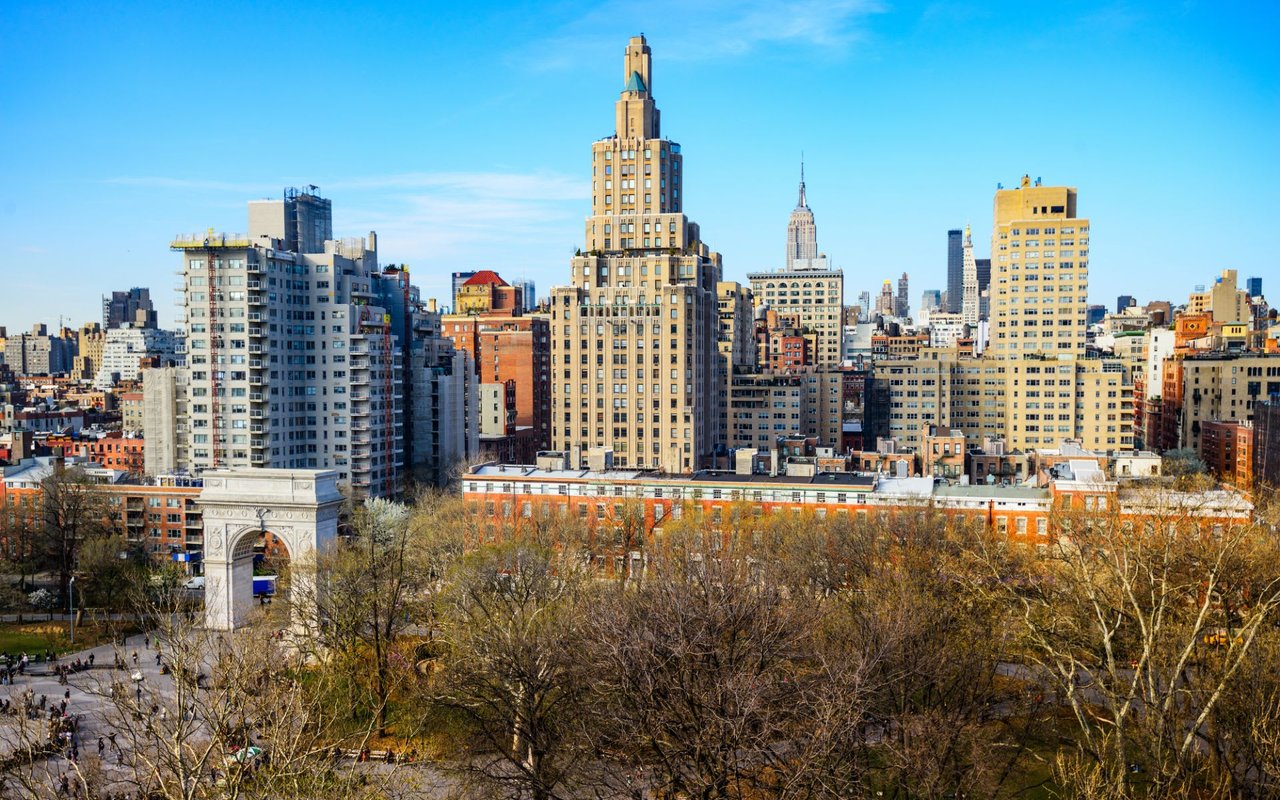
There is a reason why Greenwich Village (often simply called "The Village") remains one of the most coveted residential enclaves in the world. While the rest of Manhattan follows a rigid skyscraper-lined grid, the Village breaks the rules. Here, the streets curve at odd angles, sun-dappled cobblestones lead to hidden courtyards, and the architecture tells the story of nearly 400 years of New York history.
Greenwich Village has always been the city’s creative heart. From the "Beat Generation" writers of the 1950s to the folk music revolution of the 60s led by Bob Dylan, the neighborhood carries an artistic energy that is palpable today. This is the birthplace of the modern LGBTQ+ rights movement at the Stonewall Inn and the home of the legendary Comedy Cellar. Living here means being part of a community that values individual expression and historic preservation.
The real estate in Greenwich Village is a masterclass in charm. Unlike the steel towers of Midtown, the Village is defined by 19th-century Greek Revival row houses, Federal-style brownstones, and intimate mid-rise co-ops. Many homes feature original wood-burning fireplaces, ornate crown moldings, and private "secret gardens" tucked behind iron gates. Whether it’s a grand townhouse on West 11th Street or a chic loft in a converted warehouse, every property here is a unique piece of New York’s heritage.
At the center of it all lies Washington Square Park, framed by its iconic marble arch. It serves as the neighborhood’s communal living room—a place where world-class jazz musicians perform for passersby, chess masters challenge newcomers, and students from New York University (NYU) mingle with long-time residents. Just a few blocks west, the Hudson River Park offers miles of waterfront greenery, providing an essential escape for runners, cyclists, and sunset-seekers.
Greenwich Village is a "Walker’s Paradise" in every sense. You are never more than five minutes from a Michelin-starred meal, a cozy jazz club like Village Vanguard, or an artisanal coffee shop like Caffè Reggio (home to the first cappuccino machine in the U.S.). The neighborhood feels like a small European town where your local butcher, florist, and baker know you by name, yet the global excitement of New York City is right outside your door.
Moving to Greenwich Village is a transition into a lifestyle of history and intimacy. We’ve answered the most frequent questions from prospective buyers to help you navigate the nuances of the local market and community.
1. What is the difference between Greenwich Village and the West Village?
While the terms are often used interchangeably, "Greenwich Village" is the broader neighborhood encompassing everything from Broadway to the Hudson River. The West Village specifically refers to the area west of 6th Avenue, known for its quieter, primarily residential streets and its famous "off-grid" winding layout.
2. Why are the streets so confusing in the West Village?
The Village’s street plan was established long before the 1811 Commissioners' Plan that created Manhattan’s grid. As a result, streets like West 4th famously intersect with West 12th, and many lanes follow old property lines or natural paths. This "organized chaos" is a major part of the neighborhood's charm and helps limit heavy through-traffic.
3. Are there good schools for families in the area?
Absolutely. The Village is home to highly-regarded public options like P.S. 41 (The Greenwich Village School) and P.S. 3. There are also prestigious private institutions nearby, and the neighborhood’s low-traffic side streets make it one of the most family-friendly parts of Manhattan.
4. What is the public transit access like?
The Village has a Transit Score of 100. It is served by nearly every major subway line, including the A/C/E, B/D/F/M at West 4th St-Washington Sq, and the 1/2/3 at Christopher St and 14th St. The PATH train also provides a quick connection to New Jersey.
5. Is the neighborhood noisy due to the nightlife?
The major avenues (like 6th and 7th) and the area immediately around Washington Square Park are vibrant and lively. However, the residential side streets—such as Bank Street or Perry Street—are famously quiet and serene, often feeling more like a sleepy suburb than the center of a metropolis.
6. What are the typical property types in the Village?
You will find a mix of Pre-war Co-ops, luxury Condos, and single-family Townhouses. It is important to note that many buildings are Co-ops, which may require a board approval process, whereas newer developments like those on Charles or Jane Street offer modern Condo ownership.
7. How does the cost of living compare to other NYC areas?
Greenwich Village is a premium market. While real estate prices are among the highest in the city, residents save significantly on transportation because it is a "Walker’s Paradise" (Walk Score of 99), where daily errands and entertainment rarely require a car or even a subway ride.
8. Are there grocery stores nearby?
Yes. In addition to high-end spots like Citarella and Wegmans (Astor Place), the neighborhood is famous for its specialty shops, such as Murray’s Cheese and various independent "mom and pop" Italian markets that have been there for generations.
9. What is "The Waterway" access like?
Residents have direct access to the Hudson River Park, which features Pier 51 (a nautical-themed playground), the Pier 45 sunbathing lawns, and a continuous esplanade that runs the length of Manhattan’s west side.
10. What is the impact of NYU on the neighborhood?
NYU is woven into the fabric of the Village. While the university brings a youthful energy and supports local businesses, most of the academic buildings are concentrated around Washington Square Park, leaving the historic residential blocks to maintain their traditional, quiet character.
28,649 people live in Greenwich Village, where the median age is 39 and the average individual income is $147,040. Data provided by the U.S. Census Bureau.
Total Population
Median Age
Population Density
Average individual Income
There's plenty to do around Greenwich Village, including shopping, dining, nightlife, parks, and more. Data provided by Walk Score and Yelp.
Explore popular things to do in the area, including Big Enchilada, Garibaldi Plaza, and New View Beauty Salon.
| Name | Category | Distance | Reviews |
Ratings by
Yelp
|
|---|---|---|---|---|
| Dining | 0.24 miles | 0 reviews | 0/5 stars | |
| Active | 0.06 miles | 0 reviews | 0/5 stars | |
| Beauty | 0.23 miles | 0 reviews | 0/5 stars | |
| Beauty | 0.35 miles | 0 reviews | 0/5 stars | |
|
|
||||
|
|
||||
|
|
||||
|
|
||||
|
|
||||
|
|
Greenwich Village has 13,926 households, with an average household size of 2. Data provided by the U.S. Census Bureau. Here’s what the people living in Greenwich Village do for work — and how long it takes them to get there. Data provided by the U.S. Census Bureau. 28,649 people call Greenwich Village home. The population density is 102,744 and the largest age group is Data provided by the U.S. Census Bureau.
Total Population
Population Density Population Density This is the number of people per square mile in a neighborhood.
Median Age
Men vs Women
Population by Age Group
0-9 Years
10-17 Years
18-24 Years
25-64 Years
65-74 Years
75+ Years
Education Level
Total Households
Average Household Size
Average individual Income
Households with Children
With Children:
Without Children:
Blue vs White Collar Workers
Blue Collar:
White Collar:

MIRADOR REAL ESTATE
(212) 248-3333
[email protected]
GREENWICH VILLAGE
16 East 12th Street
New York, NY 10003
MIDTOWN
330 East 39th Street
New York, NY 10016
UPPER WEST SIDE
145 West 67th Street
New York, NY 10023
FLATIRON
60 West 23rd Street
New York, NY 10010
HOUSTON
1 Market Sq Tower
Houston, TX 77002
STAMFORD
130 Tresser Boulevard
Stamford, CT 06901
18 E 50th Street
NY, NY 10022
MIRADOR REAL ESTATE
(212) 248-3333
[email protected]
GREENWICH VILLAGE
16 East 12th Street
New York, NY 10003
MIDTOWN
330 East 39th Street
New York, NY 10016
UPPER WEST SIDE
145 West 67th Street
New York, NY 10023
FLATIRON
60 West 23rd Street
New York, NY 10010
HOUSTON
1 Market Sq Tower
Houston, TX 77002
STAMFORD
130 Tresser Boulevard
Stamford, CT 06901
18 E 50th Street
NY, NY 10022